Preambles
Context
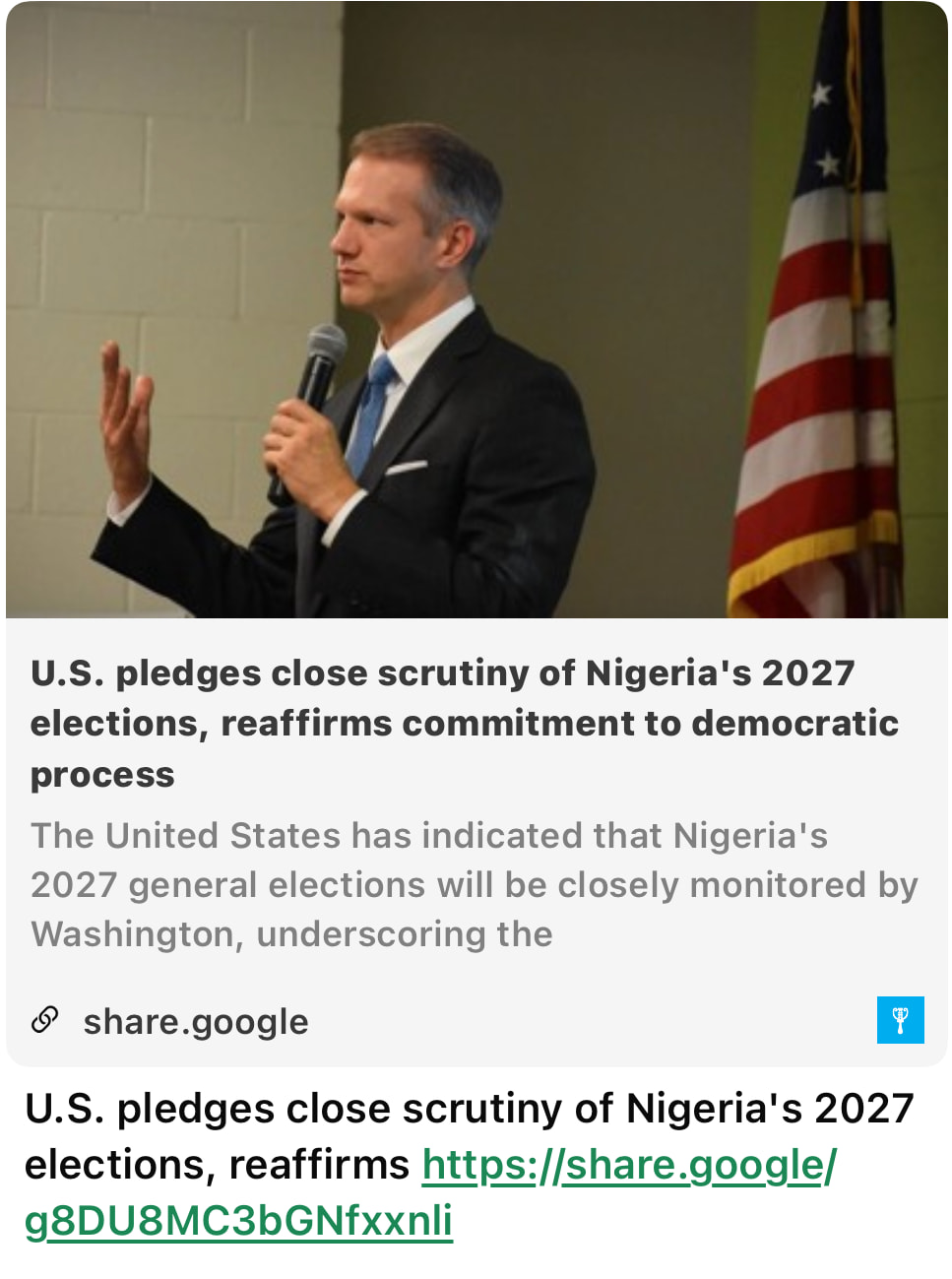
U.S. pledges close scrutiny of Nigeria’s 2027 elections, reaffirms https://share.google/g8DU8MC3bGNfxxnli
Grok
Yes, several of these countries invite international observers to their elections, though practices vary significantly by nation, with the US being the most consistent among them in recent decades.02
United States
The US regularly invites international observers, primarily through the Organization for Security and Co-operation in Europe (OSCE) Office for Democratic Institutions and Human Rights (ODIHR). This stems from its commitments under the 1990 OSCE Copenhagen Document, which includes a standing invitation for observers among participating states.42
- Observers have been deployed for every general election since 2002 (and midterms in relevant cycles).
- The most recent example was the November 2024 presidential election, with a limited OSCE/ODIHR observation mission involving a core team and long-term observers.123
- Observation is decentralized due to the US federal system, so access varies by state, but the State Department coordinates invitations.0
United Kingdom
The UK, as an OSCE participating state, has hosted OSCE observers in the past (e.g., for devolved elections in the early 2000s). It supports and recruits for OSCE missions abroad but does not routinely host large-scale international missions for general elections in the same consistent manner as the US. UK-based groups like Democracy Volunteers conduct domestic-style observations.2655
Russia
Russia has issued invitations to OSCE/ODIHR in the past (e.g., 2016 Duma elections and 2018 presidential election). However, it has increasingly restricted or declined full, independent OSCE missions in recent cycles, opting instead for limited “international visitors” or aligned observers. It did not invite OSCE observers for the 2024 presidential election, drawing criticism for violating commitments.1517
India
India’s Election Commission engages in international cooperation, including sending its officials as observers or experts abroad and hosting international election visitors’ programs. It does not appear to routinely invite comprehensive independent international observation missions for its own national elections in the same structured way as OSCE processes. India participates selectively based on invitations received.36
South Africa
South Africa regularly invites and welcomes international observers, particularly from the African Union (AU) and other bodies. For the May 2024 national and provincial elections, the AU deployed an Election Observation Mission at the invitation of the government and Independent Electoral Commission (IEC). Other groups were also accredited.4567
The last instances of meaningful invitations were recent: US (2024), South Africa (2024), with Russia having done so in prior cycles but not 2024.1267
Basis for Sending Observers to Other Countries (Especially African Nations)
Countries like the US, UK, and others (often via the EU, Commonwealth, or AU) send observers primarily to:
- Promote democratic standards, transparency, and credibility: Observation deters fraud/intimidation, builds public confidence, and provides impartial assessments based on international principles (e.g., the 2005 Declaration of Principles for International Election Observation).8687
- Support post-conflict or transitional democracies: In Africa, this is common through regional bodies like the AU (which has guidelines emphasizing invitations from host governments) or international partners, often tied to peacebuilding, governance assistance, and regional stability.87
- Foreign policy and multilateral commitments: The US, UK, and EU view it as advancing human rights, rule of law, and good governance. Missions require an official invitation from the host government or electoral body, with access agreements. Funding and deployment often come from foreign aid or democracy-support budgets.86
- Reciprocity and norms: OSCE commitments encourage mutual observation; similar principles apply in African Union contexts.
In summary, established democracies like the US and South Africa actively participate in reciprocal or regional observation to model and strengthen norms, while practices in Russia and India are more selective. Observation always depends on host invitations and operates under codes of conduct emphasizing impartiality.
ChatGPT
Yes. The US, UK, India and South Africa do invite international observers or international election visitors. Russia has done so before, but in recent elections it has not invited the main independent OSCE/ODIHR observers, while inviting friendlier or less independent groups.
- The direct answer
Country Do they invite international observers? Last clear recent example
United States Yes. Mainly through OSCE/ODIHR and OSCE Parliamentary Assembly missions. 5 November 2024 general elections. ODIHR deployed a Limited Election Observation Mission.
United Kingdom Yes. Mainly through OSCE/ODIHR. 4 July 2024 general election. ODIHR deployed an Election Assessment Mission after invitation from UK authorities.
Russia Historically yes, especially OSCE/ODIHR in earlier years. But not recently in a credible full sense. 2018 presidential election was the last clearly listed OSCE/ODIHR national election mission. In 2024, Russia did not invite OSCE observers to the presidential election.
India Yes, but often framed as international election visitors, not always full independent observer missions. 2024 Lok Sabha elections. India hosted 75 delegates from 23 countries under its International Election Visitors’ Programme.
South Africa Yes. It openly accredits domestic and international observers. 29 May 2024 national and provincial elections. SADC, AU, EISA and others observed. SADC says South Africa’s IEC invited it on 14 March 2024.
- Important distinction: “observer” is not always the same thing
There are at least three levels:
-
Full election observation mission.
This is the strongest form. Observers assess the legal framework, campaign, media, voting, counting, complaints, technology, campaign finance, and the broader political environment. The OSCE/ODIHR, EU, AU, SADC, Commonwealth, Carter Center, NDI and IRI often work in this mode. -
Election assessment mission.
This is lighter. It may not observe voting and counting across the country. For example, the UK’s 2024 ODIHR mission was an Election Assessment Mission, and ODIHR said it would not carry out systematic election-day observation. -
Election visitors’ programme.
This is more like a transparency and learning visit. India’s 2024 programme brought foreign election management bodies to witness the process and learn from India’s system, but that is not the same as a fully independent forensic observer mission.
So the answer is not just “do they invite observers?” The deeper question is: do they invite independent observers with freedom to assess the whole process and publish their own conclusions?
The US, UK and South Africa generally do. India invites international visitors and has strong election-management exchanges, though its model is often more controlled and educational than adversarial. Russia has moved away from credible independent OSCE observation in recent national elections.
- Russia is the special case
Russia belongs to the OSCE system, so in principle it is under the same mutual-observation framework as the US and UK. But in 2024, OSCE/ODIHR said Russia did not invite OSCE observers to the presidential election. ODIHR described this as contrary to Russia’s OSCE commitments and said it denied Russian voters and institutions an impartial independent assessment.
That does not mean no foreigners were present. Russia did invite other international “observers” or guests, including from friendly or sympathetic networks. But many democracy-monitoring bodies distinguish between independent observers and politically selected visitors. EPDE, for example, described many of the 2024 Russian foreign “observers” as fake or non-credible observers.
So Russia’s position is: yes, it may invite foreign guests; no, it did not recently invite the most credible independent OSCE observers.
- On what basis do they send observers to other countries?
They do not have a sovereign right to walk into another country and supervise elections. The lawful basis is usually one or more of the following.
A. Invitation by the host country
This is the first rule. International election observation normally happens because the host government or electoral commission invites or accredits observers.
For example, SADC said South Africa’s IEC invited the SADC Electoral Observation Mission to observe the 2024 elections. The AU also said its 2024 South Africa mission was deployed at the invitation of the South African government and IEC.
B. Treaty, charter, or regional commitment
Countries often join organisations whose rules include election observation. For example:
The OSCE framework applies to the US, UK, Russia and other OSCE states. OSCE documents say participating states have committed themselves to invite observers, including ODIHR, to their elections.
The SADC framework applies to Southern African countries. SADC says its principles require it to observe general elections in member states.
The AU framework comes from African Union democracy and election instruments. AU election observation is presented as part of improving democratic governance and confidence in electoral processes.
The Commonwealth observes elections in member countries and says it has observed more than 200 elections in over 40 countries since 1980.
C. International human-rights standards
The broader moral and legal basis is that genuine elections are not merely domestic rituals. They are tied to internationally recognised rights: the right to vote, the right to stand for election, freedom of expression, association, assembly, equal participation, and peaceful transfer of authority.
The Declaration of Principles for International Election Observation says genuine democratic elections express the sovereignty of the people and that voting and being elected are internationally recognised human rights.
D. Mutual scrutiny, not colonial supervision
This is the part that is often misunderstood.
When the US or UK sends observers to African countries, the proper basis is not: “We are superior, therefore we inspect you.”
The proper basis is: we are all members of a rules-based democratic community, and election credibility benefits from outside eyes.
That is why the US itself accepts OSCE observers. The UK accepts OSCE observers. South Africa accepts AU, SADC and other observers. India invites foreign election bodies. So, in principle, election observation is reciprocal.
- Why then does it feel like African countries are observed more heavily?
Because several things combine:
-
Many African countries are members of multiple observer systems at once: AU, ECOWAS/SADC/EAC, Commonwealth, EU partnerships, Carter Center, NDI, IRI, EISA, local civil-society coalitions.
-
Some African elections have higher risks of violence, incumbency abuse, weak institutions, disputed voter registers, or post-election litigation. Observers are therefore seen as confidence-builders.
-
Western donors often fund democracy-support programmes. This can be helpful, but it can also create a perception of political condescension.
-
African governments themselves often invite observers to strengthen legitimacy, reassure investors, calm opposition parties, and signal openness.
-
The global media is harsher on African elections than on some Western elections, even where Western elections also have serious problems: gerrymandering, voter suppression claims, campaign-finance distortion, disinformation, unequal media influence, foreign interference, or declining trust.
-
My own view
International observers are legitimate only if they obey four rules:
- They must be invited or properly accredited.
- They must be independent, not handpicked praise-singers.
- They must apply the same standards to rich and poor countries.
- They must observe, not command.
A good observer mission is like an independent auditor. It does not own the company. It does not run the company. But it helps outsiders and insiders trust the accounts.
A bad observer mission is political theatre. It either rubber-stamps a bad election for geopolitical reasons, or unfairly condemns an election because the “wrong” side won.
- Bottom line
The US, UK, India and South Africa do expose their elections to international eyes, though in different degrees. Russia used to do so more credibly, but its recent refusal to invite OSCE observers marks a major retreat.
So when these countries or their institutions observe African elections, the proper basis is invitation, accreditation, treaty commitments, regional rules, and international democratic standards—not a legal right to supervise another sovereign country. The fairest principle is simple:
If you observe others, you must also allow others to observe you.
Claude
Yes — with very different levels of enthusiasm.
- US: Regularly invites OSCE/ODIHR. Most recent: a Limited Election Observation Mission for the November 2024 general elections, the eleventh time ODIHR has assessed US federal elections since 2002. Osce
- UK: Also invites ODIHR regularly (2003, 2005, 2010, 2015, and again for the July 2024 general election, which got a full OSCE final report).
- Russia: Used to invite full OSCE missions (last comprehensive one was the 2004 presidential election). Since then access was progressively restricted — no observers in 2021’s Duma election, and in January 2024 Russia decided not to invite OSCE observers to its presidential election at all, the second time in a row it had done so. Osce It instead ran its own “international visitors” programme.
- India: Doesn’t invite formal monitoring observers with a mandate to assess and report. It runs an “International Election Visitors Programme” — foreign delegates and diplomats watch polling as guests, with no independent assessment report. Most recent: a 2026 programme bringing 43 delegates from 23 countries to observe elections in Assam, Kerala, Puducherry, West Bengal and Tamil Nadu. Devdiscourse
- South Africa: Invites observers extensively and has since 1994. Most recent: the May 2024 elections drew missions from SADC, the EU, the AU, the Commonwealth, and the Pan African Parliament, Daily Maverick all of which declared the elections free, fair, and credible. Daily Maverick
On what basis do they observe other countries’ elections?
- OSCE members (US, UK, Russia): Their mandate to send/receive observers comes from the 1990 Copenhagen Document and later OSCE decisions — a political commitment all 57 OSCE states signed onto, obliging them to invite ODIHR and accept its methodology.
- South Africa: Sends and receives observers under AU and SADC frameworks — the AU’s Declaration on Principles Governing Democratic Elections and the African Charter on Democracy, Elections and Governance; and SADC’s own Principles and Guidelines Governing Democratic Elections, which state SADC “shall observe all general elections held in its member states.”
- India: Rarely sends formal observer missions abroad, though it occasionally does (e.g., its CEC observed Uzbekistan’s 2021 presidential election) — usually framed as bilateral cooperation/MOUs between election bodies rather than a binding regional commitment.
So the “basis” is generally treaty-like regional commitments (OSCE, AU, SADC, Commonwealth), not something imposed by outside powers on Africa specifically — African states themselves (through the AU/SADC) are usually the ones deploying and receiving observers under frameworks they helped write.