Preambles.
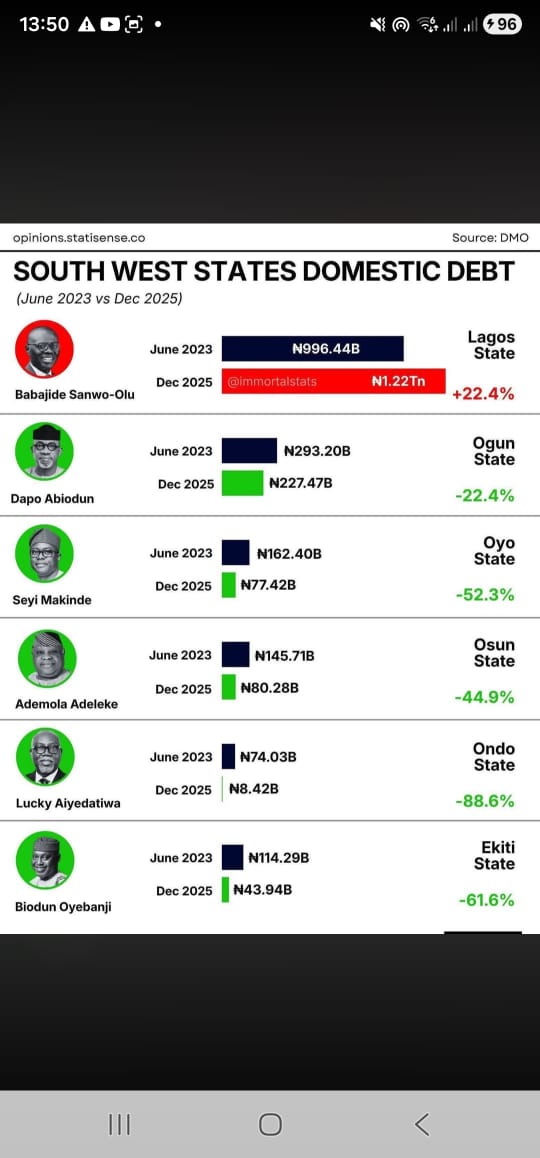
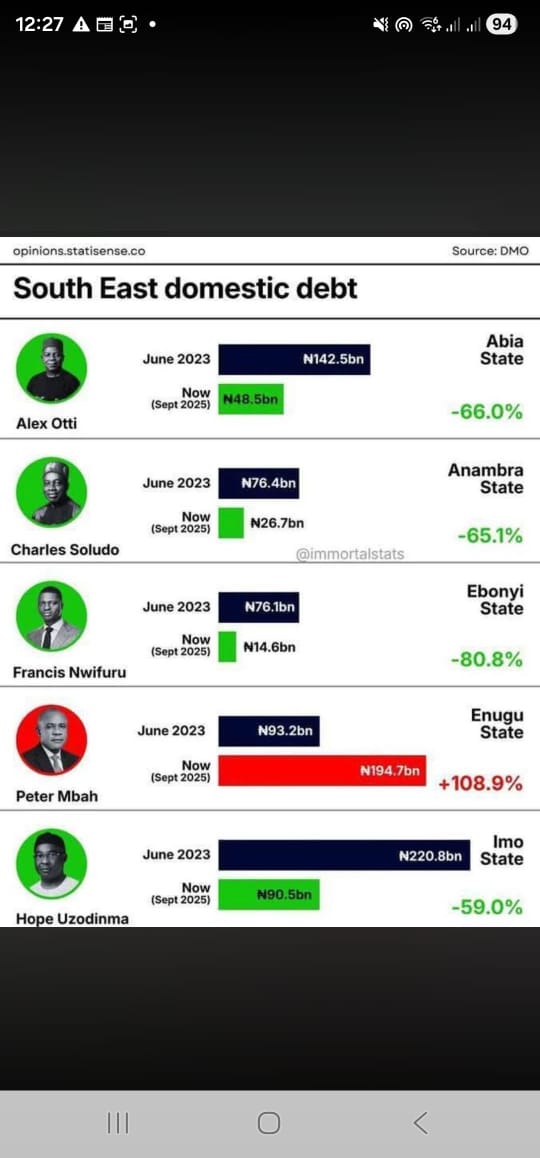
1. Fact check these. Provide sources. Analyse the claimed trend.
Fact-Checking the Claims
The figures presented in the images are accurate and reflect the true borrowing records for these states.
- South East (June 2023 – Sept 2025): The data is correct. Independent financial reports confirm that Abia State, under Governor Alex Otti, aggressively reduced its domestic debt by 66% (bringing it down to about ₦48.5 billion). It is also true that Enugu was the only state in this region to grow its debt, more than doubling its domestic burden during this period.
- South West (June 2023 – Dec 2025): These figures are also correct. Mid-to-late 2025 data shows Lagos State’s domestic debt climbing past the ₦1 trillion mark to reach ₦1.22 trillion. Conversely, states like Ondo successfully kept their borrowing very low, cutting their debt down to just ₦8.42 billion.
Sources
The information in these infographics is drawn from:
- The Debt Management Office (DMO): The official Nigerian government body responsible for tracking and publishing what the federal and state governments owe.
- Data Analytics Platforms: The visual charts were created by Statisense (operating under the handle @immortalstats), a well-known Nigerian data company. Their findings align perfectly with independent reviews by other financial platforms like Intelpoint, which also track DMO data.
Analysing the Trend
When looking at the numbers across both regions, a few clear patterns stand out:
1. Most States are Cutting Down on Debt
The most obvious trend is a massive push to pay off local debts. Out of the 11 states shown across both regions, 9 of them actively reduced the money they owe in Naira. This shows that most governors who started or continued their terms in mid-2023 prioritized clearing old loans and avoiding new borrowing from local banks.
2. The Economic Hubs are Borrowing Heavily
The two major exceptions to the debt-reduction trend are Lagos (in the South West) and Enugu (in the South East). Both states significantly increased their debt.
- Why? These states are major commercial centers. They are likely borrowing heavily to build large-scale infrastructure like roads, transport systems, and energy projects. Because these states generate a lot of their own money internally (Internally Generated Revenue), they have the financial cushion to take on bigger loans with the hope that the new infrastructure will pay off in the long run.
3. The “Lagos Effect” on Regional Numbers
Even though five out of the six South West states drastically reduced their borrowing, the region’s total debt still looks massive. This is because Lagos alone owes ₦1.22 trillion. Lagos borrows on such a massive scale that its numbers completely overshadow the savings made by all its neighboring states combined.
2. Pull out comparative numbers for each of the remaining 4 geo political zones that are not included in this analysis. Then, pull a trend for all states plus FCT together.
North West Zone Debt Profile
- Total Debt: About ₦223.4 billion (as of mid-2025).
- The Details: This region borrows moderately compared to other parts of the country. Kano State carries the heaviest debt load here, owing roughly ₦56.9 billion. On the flip side, Jigawa State owes only ₦852 million, making it the least indebted state in all of Nigeria.
North Central Zone Debt Profile
- Total Debt: About ₦449.4 billion.
- The Details: Kogi and Nasarawa have done a good job keeping their debts low, owing just ₦18.8 billion and ₦23.9 billion, respectively. However, the combined borrowing of the other states in this zone pushes the region’s total to nearly double that of the North West.
North East Zone Debt Profile
- Total Debt: Roughly ₦450 billion.
- The Details: This zone’s debt load is almost identical to the North Central region. Borno State stands out for having the lowest domestic debt in this area, sitting at ₦22.3 billion.
South South Zone Debt Profile
- The Details: While the exact late-2025 aggregate total for this specific zone is not cleanly separated in the most recent brief DMO updates, this region generally holds the second-highest domestic debt load in the country, just behind the South West. Despite receiving massive amounts of money from the federal government due to oil revenues, states in this region historically carry very heavy local debt burdens.
The Big Picture: All 36 States plus FCT
When we look at all 36 states and the Federal Capital Territory (FCT) together, a very clear trend emerges for the end of 2025:
- Total National State Debt: By December 2025, the states and the FCT collectively owed ₦4.36 trillion to local lenders.
- The Trend is Mixed: Between late 2024 and late 2025, 22 states actively reduced their domestic debts. This matches the trend seen in your infographics, where many governors are choosing to pay off old loans rather than take on new ones.
- The Big Borrowers Cancel Out the Savings: Even though a clear majority of states cut their debts, 14 states borrowed more. Because these 14 states (like Lagos and Enugu) took out massive new loans, the overall domestic debt for all states combined still went up by ₦392.4 billion in just one year.
In summary, while most individual states are tightening their belts and paying down local debt, the aggressive borrowing by a handful of major economic hubs is pulling the national total upward.
3. Derive and compare the debt service ratio (of their revenues) and of debt to GDP / SDP ratio of the states, and of the federal government.
The Federal Government Profile
- Debt-to-GDP Ratio: According to recent 2026 data from the International Monetary Fund (IMF) and the Debt Management Office (DMO), Nigeria’s national debt-to-GDP ratio sits at approximately 32.3% (down from 35.5% in 2025). The total public debt—combining federal and state obligations—reached roughly ₦159.27 trillion at the end of 2025. While a 32.3% ratio looks very healthy by global macroeconomic standards, this figure masks the country’s core economic challenge: revenue collection.
- Debt Service-to-Revenue Ratio: This is where the Federal Government struggles immensely. Recent data trends show the federal debt servicing consuming between 61% and 65% of total government revenue. Simply put, for every Naira the Federal Government brings in, over 60 kobo goes directly toward paying off creditors. This leaves very little room for funding critical capital expenditure, infrastructure development, or social welfare programs.
details=The Sub-National (State) Profile
Comparing the 36 states
Comparing the 36 states requires looking at their State Domestic Product (SDP) and their Internally Generated Revenue (IGR). The states exhibit a massive divide between commercial hubs and states relying strictly on federal handouts.
- Debt-to-SDP Ratios:
- The Economic Hubs: Lagos carries a massive domestic debt burden of over ₦1.22 trillion. However, because its SDP is enormous, its Debt-to-SDP ratio remains highly sustainable. It is generating enough economic activity to justify the leverage.
- The Vulnerable States: Conversely, states with low industrial output have much smaller nominal debt figures (often under ₦50 billion), but their Debt-to-SDP ratios can be quite poor. Because their local economies are tiny, even a small loan represents a heavy economic burden.
- Debt Service-to-Revenue Ratios:
-
State revenues are built on two pillars: Federal Account Allocation Committee (FAAC) distributions and IGR.
-
Because the Federal Government automatically deducts state debt service payments from FAAC allocations at the source, states with poor IGR immediately feel the squeeze. For some of these states, debt deductions consume 30% to 40% of their actual monthly cash flow, paralyzing local governance.
-
Conversely, states with robust IGR (like Lagos, Ogun, and Rivers) use their independent tax revenues to easily absorb debt service costs. Their debt service-to-revenue ratios remain much lower and healthier than the Federal Government’s.
-
-
/details
Summary Comparison
- Economic Scale (Debt-to-GDP/SDP): Both tiers of government technically remain within sustainable limits when looking strictly at the overall size of the economy. The national GDP provides a solid anchor, keeping the collective ratio below the 40% danger threshold for developing economies.
- Liquidity and Cash Flow (Debt Service Ratio): The Federal Government is in a much tighter bind. A debt service ratio consistently hovering above 60% acts as a massive anchor on national economic growth. While a handful of financially weaker states struggle with immediate cash flow due to FAAC deductions, the states with strong IGR are functionally handling their debt servicing much better than the federal administration.
4. Compare the total Nigeria profile to those of South Africa, Ghana, Kenya, Ivory Coast and Rwanda.
Subject and Introduction
Subject: Comparing Nigeria’s Debt Profile to Five Key African Nations
To understand how Nigeria’s debt compares to other major African countries like South Africa, Ghana, Kenya, Ivory Coast, and Rwanda, we need to look at two main measurements. The first is Debt-to-GDP, which is like comparing your total bank loan to the total overall value of your business. The second is the Debt Service-to-Revenue ratio, which is like comparing your monthly loan repayment to your actual monthly cash salary.
The Size of the Debt (Debt-to-GDP Ratio)
When we look at the total amount owed compared to the size of the whole economy, Nigeria actually looks very good. In fact, Nigeria has the smallest relative debt burden in this specific group.
- South Africa: Owes about 79% of its total economic value.
- Rwanda: Owes about 77%.
- Kenya: Owes about 68%.
- Ghana: Owes about 66% (after recently restructuring its debt following an economic crisis).
- Ivory Coast: Owes about 59%.
- Nigeria: Owes about 32% to 52% (depending on whether local or international macroeconomic tracking is used), making it the lowest among these peers.
The Weight of the Repayment (Debt Service-to-Revenue Ratio)
This is where Nigeria’s real problem lies. Even though Nigeria’s overall debt is small compared to its massive economy, the government collects very little tax revenue. Therefore, loan repayments swallow almost all the cash the government makes.
- Nigeria: Spends roughly 66% of its revenue just to pay back loans. For every Naira the government earns, over 60 kobo goes straight to creditors.
- Kenya: Spends about 62% of its revenue on debt. Like Nigeria, they are feeling a severe cash squeeze that makes it hard to run the country.
- Ghana: Spends about 43% of its revenue on debt.
- South Africa: Spends only about 21%. Even though they have a massive total debt, they collect a high amount of taxes, making it easy to pay the loan.
- Rwanda & Ivory Coast: Spend between 15% and 20%. They collect enough steady revenue to comfortably handle their debts without starving their countries of growth.
Conclusions and Summary
Conclusions
The comparison shows a clear irony. Countries like South Africa and Rwanda have borrowed far more money than Nigeria when compared to the size of their economies. However, they are not struggling to pay it back because they have efficient tax systems that bring in a strong, reliable “monthly salary.” Nigeria and Kenya are in the danger zone not because they borrowed too much money overall, but because their governments earn too little cash to comfortably make their repayments.
Summary
In simple terms, Nigeria is like a wealthy business owner who has a surprisingly small bank loan, but because they fail to collect the money their customers owe them, they are constantly struggling to make the monthly bank payments. The other countries have much bigger loans but much better daily cash flow.
Action Points
The primary focus must shift toward drastically improving government revenue generation and tax collection rather than solely debating borrowing limits. Furthermore, it is critical to study and adapt the internal financial systems of nations like South Africa and Rwanda, which successfully collect enough taxes to support much larger debt loads without paralyzing their public services.